BuzzMagnet, An Influencer–Brand Collaboration Platform
BuzzMagnet, An Influencer–Brand Collaboration Platform
BuzzMagnet, An Influencer–Brand Collaboration Platform
Project Overview
Project Overview
Project Overview
What is BuzzMagnet?
What is BuzzMagnet?
What is BuzzMagnet?
BuzzMagnet is a B2B2C SaaS platform that connects brands with the right influencers to collaborate on marketing campaigns all in one place. It enables both parties to discover, communicate, collaborate, and track campaign performance. The platform streamlines the entire influencer-brand collaboration workflow including Campaign creation by businesses, Influencer bidding and onboarding, Messaging and agreement flow, Post-delivery verification, Performance analytics & reporting, Admin and employee-side moderation tools
BuzzMagnet is a B2B2C SaaS platform that connects brands with the right influencers to collaborate on marketing campaigns all in one place. It enables both parties to discover, communicate, collaborate, and track campaign performance. The platform streamlines the entire influencer-brand collaboration workflow including Campaign creation by businesses, Influencer bidding and onboarding, Messaging and agreement flow, Post-delivery verification, Performance analytics & reporting, Admin and employee-side moderation tools
BuzzMagnet is a B2B2C SaaS platform that connects brands with the right influencers to collaborate on marketing campaigns all in one place. It enables both parties to discover, communicate, collaborate, and track campaign performance. The platform streamlines the entire influencer-brand collaboration workflow including Campaign creation by businesses, Influencer bidding and onboarding, Messaging and agreement flow, Post-delivery verification, Performance analytics & reporting, Admin and employee-side moderation tools
My Role
My Role
My Role
Product Designer (UX/UI)
Product Designer (UX/UI)
Product Designer (UX/UI)
Timeline
Timeline
Timeline
8 Months
8 Months
8 Months
Industry
Industry
Industry
Influencer Marketing
(B2B2C SaaS)
Influencer Marketing
(B2B2C SaaS)
Influencer Marketing
(B2B2C SaaS)
Deliverables
Deliverables
Deliverables
Complete UX Strategy for a 0→1 Product
Complete UX Strategy for a 0→1 Product
Complete UX Strategy for a 0→1 Product
End-to-End Web and Mobile Platform Design for 3 User Types (Business, Influencer, Admin)
End-to-End Web and Mobile Platform Design for 3 User Types (Business, Influencer, Admin)
End-to-End Web and Mobile Platform Design for 3 User Types (Business, Influencer, Admin)
Research results, Information Architecture (IA), User Flows, Wireframes & High-Fidelity UI
Research results, Information Architecture (IA), User Flows, Wireframes & High-Fidelity UI
Research results, Information Architecture (IA), User Flows, Wireframes & High-Fidelity UI
Responsive UI Design System built from scratch in Figma
Responsive UI Design System built from scratch in Figma
Responsive UI Design System built from scratch in Figma
Admin Dashboard UX with Report Management & Approval Flows
Admin Dashboard UX with Report Management & Approval Flows
Admin Dashboard UX with Report Management & Approval Flows
Brand Identity Design – Logo, Typography, and Visual Language
Brand Identity Design – Logo, Typography, and Visual Language
Brand Identity Design – Logo, Typography, and Visual Language
Design Handoff & Developer Collaboration (remote)
Design Handoff & Developer Collaboration (remote)
Design Handoff & Developer Collaboration (remote)

Problem Framing
Problem Framing
Problem Framing
The Rise of Influencer Marketing But with a Broken Workflow
The Rise of Influencer Marketing But with a Broken Workflow
The Rise of Influencer Marketing But with a Broken Workflow
The influencer marketing industry is booming, especially among Gen Z creators and D2C brands. However, the workflow of finding, pitching, and managing collaborations remains inefficient, fragmented, and time-consuming on both sides.
The influencer marketing industry is booming, especially among Gen Z creators and D2C brands. However, the workflow of finding, pitching, and managing collaborations remains inefficient, fragmented, and time-consuming on both sides.
The influencer marketing industry is booming, especially among Gen Z creators and D2C brands. However, the workflow of finding, pitching, and managing collaborations remains inefficient, fragmented, and time-consuming on both sides.

This disconnect leads to a loss of time, effort, and trust on both sides.
This disconnect leads to a loss of time, effort, and trust on both sides.
This disconnect leads to a loss of time, effort, and trust on both sides.
The Problem
The Problem
The Problem
Growing brands and independent influencers struggle to find each other, connect meaningfully, and manage collaborations efficiently. They juggle multiple disconnected tools, unclear expectations, and lack visibility into outcomes. There’s a clear need for a unified, transparent, and interest-aligned platform that simplifies discovery, streamlines collaboration, and fosters long-term growth all in one place reducing time and effort.
Growing brands and independent influencers struggle to find each other, connect meaningfully, and manage collaborations efficiently. They juggle multiple disconnected tools, unclear expectations, and lack visibility into outcomes. There’s a clear need for a unified, transparent, and interest-aligned platform that simplifies discovery, streamlines collaboration, and fosters long-term growth all in one place reducing time and effort.
Growing brands and independent influencers struggle to find each other, connect meaningfully, and manage collaborations efficiently. They juggle multiple disconnected tools, unclear expectations, and lack visibility into outcomes. There’s a clear need for a unified, transparent, and interest-aligned platform that simplifies discovery, streamlines collaboration, and fosters long-term growth all in one place reducing time and effort.
Problem Areas Identified
Problem Areas Identified
Problem Areas Identified
Through ecosystem analysis, platform audits, and interviews with influencers and businesses, we identified five critical gaps in how influencer-brand collaborations are initiated, managed, and optimized today. These gaps shaped our UX priorities in building BuzzMagnet.
Through ecosystem analysis, platform audits, and interviews with influencers and businesses, we identified five critical gaps in how influencer-brand collaborations are initiated, managed, and optimized today. These gaps shaped our UX priorities in building BuzzMagnet.

Hypothesis Statement
Hypothesis Statement
Hypothesis Statement
We believe that by building a two-sided platform where influencers and businesses can discover each other based on shared interests, campaign needs, and content preferences and by streamlining the entire collaboration process from outreach to analytics we can reduce operational inefficiencies, improve match quality, and drive better outcomes for both parties.
We believe that by building a two-sided platform where influencers and businesses can discover each other based on shared interests, campaign needs, and content preferences and by streamlining the entire collaboration process from outreach to analytics we can reduce operational inefficiencies, improve match quality, and drive better outcomes for both parties.
We believe that by building a two-sided platform where influencers and businesses can discover each other based on shared interests, campaign needs, and content preferences and by streamlining the entire collaboration process from outreach to analytics we can reduce operational inefficiencies, improve match quality, and drive better outcomes for both parties.
Vision & Product Goals
Vision & Product Goals
Vision & Product Goals
The vision for BuzzMagnet was to build a seamless, scalable, and intelligent platform that bridges the gap between brands and influencers enabling faster, smarter, and more transparent collaborations. Rather than simply connecting users, the goal was to design a fully integrated ecosystem that supports the entire influencer marketing journey from discovery and bidding to messaging, collaboration, and performance reporting all within a single platform.
As the sole designer, I was responsible for ensuring that every screen, flow, and interaction aligned with both business objectives and user needs, while also laying the foundation for long-term scalability and product evolution.
The vision for BuzzMagnet was to build a seamless, scalable, and intelligent platform that bridges the gap between brands and influencers enabling faster, smarter, and more transparent collaborations. Rather than simply connecting users, the goal was to design a fully integrated ecosystem that supports the entire influencer marketing journey from discovery and bidding to messaging, collaboration, and performance reporting all within a single platform.
As the sole designer, I was responsible for ensuring that every screen, flow, and interaction aligned with both business objectives and user needs, while also laying the foundation for long-term scalability and product evolution.
The vision for BuzzMagnet was to build a seamless, scalable, and intelligent platform that bridges the gap between brands and influencers enabling faster, smarter, and more transparent collaborations. Rather than simply connecting users, the goal was to design a fully integrated ecosystem that supports the entire influencer marketing journey from discovery and bidding to messaging, collaboration, and performance reporting all within a single platform.
As the sole designer, I was responsible for ensuring that every screen, flow, and interaction aligned with both business objectives and user needs, while also laying the foundation for long-term scalability and product evolution.

User Research
User Research
User Research
Why User Research?
Why User Research?
Why User Research?
Since BuzzMagnet was being built from scratch (0 → 1), understanding the needs of both influencers and businesses was crucial. As two distinct user groups with different goals and pain points, we needed to explore how each currently approaches collaborations and what gaps exist in the current process.
Since BuzzMagnet was being built from scratch (0 → 1), understanding the needs of both influencers and businesses was crucial. As two distinct user groups with different goals and pain points, we needed to explore how each currently approaches collaborations and what gaps exist in the current process.
Since BuzzMagnet was being built from scratch (0 → 1), understanding the needs of both influencers and businesses was crucial. As two distinct user groups with different goals and pain points, we needed to explore how each currently approaches collaborations and what gaps exist in the current process.
We focused on uncovering →
We focused on uncovering →
We focused on uncovering →
“How users choose and evaluate collaborations”
“Key blockers in current communication workflows”
“What trust signals each side looks for”
“Expectations around pricing, deliverables, and reporting”
“Tools they currently use and what’s missing”
“How users choose and evaluate collaborations”
“Key blockers in current communication workflows”
“What trust signals each side looks for”
“Expectations around pricing, deliverables, and reporting”
“Tools they currently use and what’s missing”
“How users choose and evaluate collaborations”
“Key blockers in current communication workflows”
“What trust signals each side looks for”
“Expectations around pricing, deliverables, and reporting”
“Tools they currently use and what’s missing”
Research Ownership & Collaboration
Research Ownership & Collaboration
Research Ownership & Collaboration
User research was conducted as a collaborative effort between me (Product Designer) and the Product Manager. The responsibilities were divided as follows:
User research was conducted as a collaborative effort between me (Product Designer) and the Product Manager. The responsibilities were divided as follows:
User research was conducted as a collaborative effort between me (Product Designer) and the Product Manager. The responsibilities were divided as follows:
→ Product Manager
→ Product Manager
Led primary research: conducted 1:1 user interviews and informal user calls
Led primary research: conducted 1:1 user interviews and informal user calls
Led primary research: conducted 1:1 user interviews and informal user calls
→ My Role (Designer)
→ My Role (Designer)
Handled secondary research, including competitor benchmarking, social listening, and industry pattern analysis. Also synthesized insights from all sources to inform design flows and decisions
Handled secondary research, including competitor benchmarking, social listening, and industry pattern analysis. Also synthesized insights from all sources to inform design flows and decisions
Handled secondary research, including competitor benchmarking, social listening, and industry pattern analysis. Also synthesized insights from all sources to inform design flows and decisions
We regularly aligned on findings, discussed patterns, and co-developed a set of key insights that directly influenced the product structure and features.
We regularly aligned on findings, discussed patterns, and co-developed a set of key insights that directly influenced the product structure and features.
We regularly aligned on findings, discussed patterns, and co-developed a set of key insights that directly influenced the product structure and features.

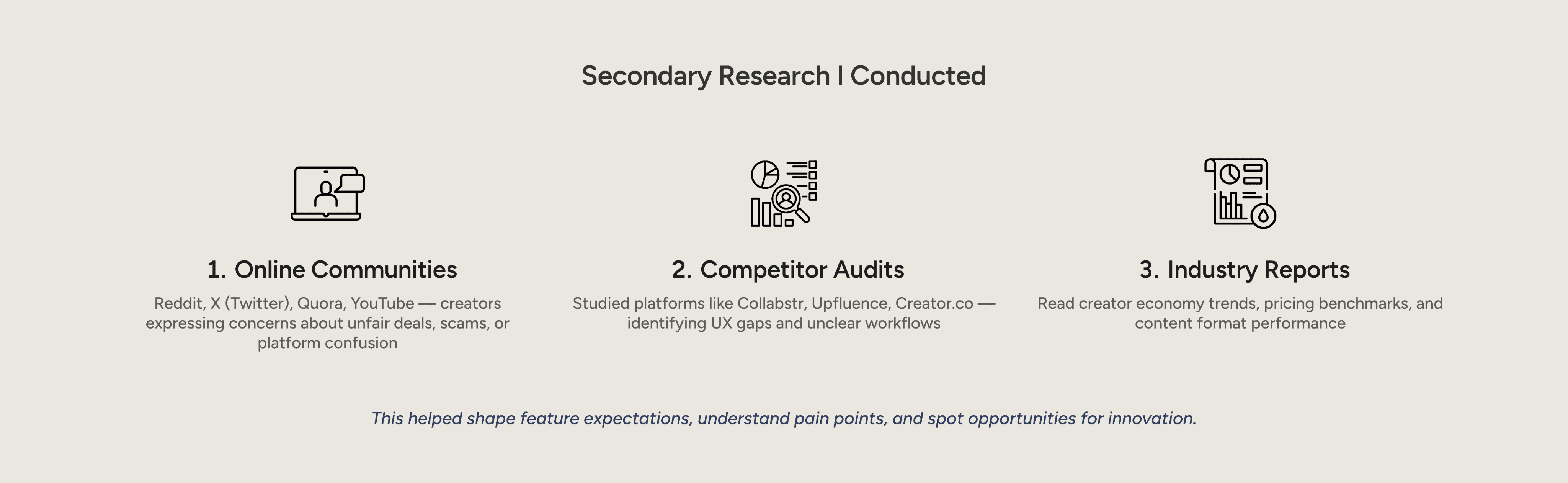


User research became the foundation of every design decision. From dashboards to analytics to approval workflows every feature was grounded in real creator and business pain points.
User research became the foundation of every design decision. From dashboards to analytics to approval workflows every feature was grounded in real creator and business pain points.
User research became the foundation of every design decision. From dashboards to analytics to approval workflows every feature was grounded in real creator and business pain points.


While the primary focus was on designing seamless experiences for Business Users and Influencers, I also contributed to internal admin workflows to support moderation, approvals, and report handling.
While the primary focus was on designing seamless experiences for Business Users and Influencers, I also contributed to internal admin workflows to support moderation, approvals, and report handling.
While the primary focus was on designing seamless experiences for Business Users and Influencers, I also contributed to internal admin workflows to support moderation, approvals, and report handling.
Information Architecture
Information Architecture
Information Architecture
Designing for a Multi-User, Multi-Role Ecosystem
Designing for a Multi-User, Multi-Role Ecosystem
Designing for a Multi-User, Multi-Role Ecosystem
Since BuzzMagnet was not a single-user platform, the first step was to architect the entire experience based on user roles and their goals.
Since BuzzMagnet was not a single-user platform, the first step was to architect the entire experience based on user roles and their goals.
Since BuzzMagnet was not a single-user platform, the first step was to architect the entire experience based on user roles and their goals.
I wasn’t just designing a product, I was designing an ecosystem where influencers, businesses, employees, and admins could all operate with different permissions, features, and expectations.
I wasn’t just designing a product, I was designing an ecosystem where influencers, businesses, employees, and admins could all operate with different permissions, features, and expectations.
I wasn’t just designing a product, I was designing an ecosystem where influencers, businesses, employees, and admins could all operate with different permissions, features, and expectations.
Why Information Architecture Mattered Early
Why Information Architecture Mattered Early
Why Information Architecture Mattered Early
BuzzMagnet supported three distinct user types Influencers, Business Users, and Employees/Admins each with their own workflows, dashboards, permissions, and responsibilities. These roles were deeply interconnected through core actions like bidding, messaging, approvals, and performance reporting.
Without a strong IA:
Navigation could become confusing
Role-specific actions might overlap or conflict
Scaling features would create friction rather than flow
So early in the process, I mapped out user roles, actions, and navigation flows to create a clear, role-driven structure. This foundation enabled scalable UX flows, simplified dashboard access, and ensured a clean transition from wireframes to high-fidelity design.
BuzzMagnet supported three distinct user types Influencers, Business Users, and Employees/Admins each with their own workflows, dashboards, permissions, and responsibilities. These roles were deeply interconnected through core actions like bidding, messaging, approvals, and performance reporting.
Without a strong IA:
Navigation could become confusing
Role-specific actions might overlap or conflict
Scaling features would create friction rather than flow
So early in the process, I mapped out user roles, actions, and navigation flows to create a clear, role-driven structure. This foundation enabled scalable UX flows, simplified dashboard access, and ensured a clean transition from wireframes to high-fidelity design.
BuzzMagnet supported three distinct user types Influencers, Business Users, and Employees/Admins each with their own workflows, dashboards, permissions, and responsibilities. These roles were deeply interconnected through core actions like bidding, messaging, approvals, and performance reporting.
Without a strong IA:
Navigation could become confusing
Role-specific actions might overlap or conflict
Scaling features would create friction rather than flow
So early in the process, I mapped out user roles, actions, and navigation flows to create a clear, role-driven structure. This foundation enabled scalable UX flows, simplified dashboard access, and ensured a clean transition from wireframes to high-fidelity design.


From Planning to Wireframes
From Planning to Wireframes
From Planning to Wireframes


What It Enabled
What It Enabled
What It Enabled
Validated core user journeys early by mapping out influencer, business, and admin interactions before high-fidelity work began.
Identified usability gaps such as unclear actions, over-cluttered dashboards, and missing feedback states — and fixed them before design polishing.
Streamlined feature prioritization with the team by visualizing flows like multi-business management, analytics, and bidding interactions in low fidelity.
Enabled smoother stakeholder alignment — wireframes served as a communication bridge between me, the product manager, and developers during async discussions.
Saved development time and reduced rework by resolving navigation and IA conflicts early.
Validated core user journeys early by mapping out influencer, business, and admin interactions before high-fidelity work began.
Identified usability gaps such as unclear actions, over-cluttered dashboards, and missing feedback states — and fixed them before design polishing.
Streamlined feature prioritization with the team by visualizing flows like multi-business management, analytics, and bidding interactions in low fidelity.
Enabled smoother stakeholder alignment — wireframes served as a communication bridge between me, the product manager, and developers during async discussions.
Saved development time and reduced rework by resolving navigation and IA conflicts early.
Validated core user journeys early by mapping out influencer, business, and admin interactions before high-fidelity work began.
Identified usability gaps such as unclear actions, over-cluttered dashboards, and missing feedback states — and fixed them before design polishing.
Streamlined feature prioritization with the team by visualizing flows like multi-business management, analytics, and bidding interactions in low fidelity.
Enabled smoother stakeholder alignment — wireframes served as a communication bridge between me, the product manager, and developers during async discussions.
Saved development time and reduced rework by resolving navigation and IA conflicts early.


Core Features & UX Flows
Core Features & UX Flows
Core Features & UX Flows
This section captures the most impactful user-facing and system-level features I designed across BuzzMagnet, showcasing how thoughtful UX decisions streamlined collaboration between influencers and brands.
This section captures the most impactful user-facing and system-level features I designed across BuzzMagnet, showcasing how thoughtful UX decisions streamlined collaboration between influencers and brands.
This section captures the most impactful user-facing and system-level features I designed across BuzzMagnet, showcasing how thoughtful UX decisions streamlined collaboration between influencers and brands.
Verified Influencer Discovery Flow
Verified Influencer Discovery Flow
Verified Influencer Discovery Flow

b. AdPost Bidding & Selection Flow
b. AdPost Bidding & Selection Flow

c. Collaboration & In-App Messaging
c. Collaboration & In-App Messaging

d. Performance & ROI Analytics Page
d. Performance & ROI Analytics Page
d. Performance & ROI Analytics Page
Private
e. Trust & Safety Mechanisms
e. Trust & Safety Mechanisms
e. Trust & Safety Mechanisms

f. Empty States, Load cases & Status Indicators
f. Empty States, Load cases & Status Indicators
f. Empty States, Load cases & Status Indicators

“The core features of BuzzMagnet weren’t designed in isolation. Every screen, flow, and interaction was crafted by thinking deeply about user context, ecosystem logic, and how different roles interact within the platform.”
“The core features of BuzzMagnet weren’t designed in isolation. Every screen, flow, and interaction was crafted by thinking deeply about user context, ecosystem logic, and how different roles interact within the platform.”
“The core features of BuzzMagnet weren’t designed in isolation. Every screen, flow, and interaction was crafted by thinking deeply about user context, ecosystem logic, and how different roles interact within the platform.”
Challenges & How I Solved Them
Challenges & How I Solved Them
Challenges & How I Solved Them
CHALLENGE 1
Designing the Admin/Employee Dashboard from Scratch
CHALLENGE 1
Designing the Admin/Employee Dashboard from Scratch
CHALLENGE 1
Designing the Admin/Employee Dashboard from Scratch
Unlike user-facing flows, I had never designed an internal dashboard for employees or moderators before. The challenge was to design something highly functional, low-friction, and scalable — all while keeping clarity for different types of admin roles (manual approvals, report handlers, business verifiers, etc.)
Unlike user-facing flows, I had never designed an internal dashboard for employees or moderators before. The challenge was to design something highly functional, low-friction, and scalable — all while keeping clarity for different types of admin roles (manual approvals, report handlers, business verifiers, etc.)
Unlike user-facing flows, I had never designed an internal dashboard for employees or moderators before. The challenge was to design something highly functional, low-friction, and scalable — all while keeping clarity for different types of admin roles (manual approvals, report handlers, business verifiers, etc.)
My Approach:
Conducted multi-round discussions with the product manager and intrapreneur to understand backend workflows.
We did brainstorming sessions on sticky notes and FigJam to define logical grouping and role-specific access.
After early prototypes, I ran usability tests to test how intuitive the information hierarchy was.
My Approach:
Conducted multi-round discussions with the product manager and intrapreneur to understand backend workflows.
We did brainstorming sessions on sticky notes and FigJam to define logical grouping and role-specific access.
After early prototypes, I ran usability tests to test how intuitive the information hierarchy was.
My Approach:
Conducted multi-round discussions with the product manager and intrapreneur to understand backend workflows.
We did brainstorming sessions on sticky notes and FigJam to define logical grouping and role-specific access.
After early prototypes, I ran usability tests to test how intuitive the information hierarchy was.
CHALLENGE 2
Balancing Two Different User Types in One Platform
CHALLENGE 2
Balancing Two Different User Types in One Platform
CHALLENGE 2
Balancing Two Different User Types in One Platform
BuzzMagnet served both influencers and business users, with completely different goals, pain points, and mental models. Designing flows that were tailored yet cohesive across the platform was tricky — especially around the bidding and collaboration lifecycle.
BuzzMagnet served both influencers and business users, with completely different goals, pain points, and mental models. Designing flows that were tailored yet cohesive across the platform was tricky — especially around the bidding and collaboration lifecycle.
BuzzMagnet served both influencers and business users, with completely different goals, pain points, and mental models. Designing flows that were tailored yet cohesive across the platform was tricky — especially around the bidding and collaboration lifecycle.
My Approach:
Created separate onboarding flows that immediately spoke to the user’s identity and use-case.
Maintained consistent visual language across both sides while personalizing dashboard KPIs, flows, and copy.
Defined parallel UX flows but reused components (e.g., Chatroom, Report Center) to maintain UI economy
My Approach:
Created separate onboarding flows that immediately spoke to the user’s identity and use-case.
Maintained consistent visual language across both sides while personalizing dashboard KPIs, flows, and copy.
Defined parallel UX flows but reused components (e.g., Chatroom, Report Center) to maintain UI economy
My Approach:
Created separate onboarding flows that immediately spoke to the user’s identity and use-case.
Maintained consistent visual language across both sides while personalizing dashboard KPIs, flows, and copy.
Defined parallel UX flows but reused components (e.g., Chatroom, Report Center) to maintain UI economy
CHALLENGE 3
Remote Communication with Developers
CHALLENGE 3
Remote Communication with Developers
CHALLENGE 3
Remote Communication with Developers
Working remotely made it challenging to align the design intentions with the development implementation. Misunderstandings around layout behaviors, logic behind features (like bidding filters or verification systems), and micro-interactions occasionally led to rework or delays.
Working remotely made it challenging to align the design intentions with the development implementation. Misunderstandings around layout behaviors, logic behind features (like bidding filters or verification systems), and micro-interactions occasionally led to rework or delays.
Working remotely made it challenging to align the design intentions with the development implementation. Misunderstandings around layout behaviors, logic behind features (like bidding filters or verification systems), and micro-interactions occasionally led to rework or delays.
My Approach:
I introduced shared Figma prototypes with detailed annotations and notes.
During weekly check-ins, I created clickable flows to walk the dev team through the UX logic and user interactions.
I also prepared handoff documentation (spacing, color tokens, and font styles) to reduce guesswork.
My Approach:
I introduced shared Figma prototypes with detailed annotations and notes.
During weekly check-ins, I created clickable flows to walk the dev team through the UX logic and user interactions.
I also prepared handoff documentation (spacing, color tokens, and font styles) to reduce guesswork.
My Approach:
I introduced shared Figma prototypes with detailed annotations and notes.
During weekly check-ins, I created clickable flows to walk the dev team through the UX logic and user interactions.
I also prepared handoff documentation (spacing, color tokens, and font styles) to reduce guesswork.
These challenges made this project one of the most formative experiences in my UX journey. I not only delivered a user-centered platform but also made conscious efforts to build it in a scalable way ensuring the design system, flows, and admin modules could support growth and future feature additions.
These challenges made this project one of the most formative experiences in my UX journey. I not only delivered a user-centered platform but also made conscious efforts to build it in a scalable way ensuring the design system, flows, and admin modules could support growth and future feature additions.
These challenges made this project one of the most formative experiences in my UX journey. I not only delivered a user-centered platform but also made conscious efforts to build it in a scalable way ensuring the design system, flows, and admin modules could support growth and future feature additions.
Learnings & Outcomes
Learnings & Outcomes
Learnings & Outcomes
Key Learnings
Key Learnings
Key Learnings
Design Systems Matter Even for Startups
Design Systems Matter Even for Startups
Design Systems Matter Even for Startups
When building something from 0 → 1, it’s tempting to rush into screens. But I learned that investing early in IA (information architecture), naming conventions, and modularity helped us scale smoothly across 3 different user roles.
When building something from 0 → 1, it’s tempting to rush into screens. But I learned that investing early in IA (information architecture), naming conventions, and modularity helped us scale smoothly across 3 different user roles.
When building something from 0 → 1, it’s tempting to rush into screens. But I learned that investing early in IA (information architecture), naming conventions, and modularity helped us scale smoothly across 3 different user roles.
Product Thinking > Pretty Screens
Product Thinking > Pretty Screens
Product Thinking > Pretty Screens
Many features that looked “simple” had deep UX and operational implications. For example, the bidding system, report handling, and post-performance analytics needed careful thinking around
Many features that looked “simple” had deep UX and operational implications. For example, the bidding system, report handling, and post-performance analytics needed careful thinking around
Many features that looked “simple” had deep UX and operational implications. For example, the bidding system, report handling, and post-performance analytics needed careful thinking around
State management (who sees what, when)
Transparency in collaboration
Handling rejections and disputes
I learned to always ask questions like “What happens after this screen?” or “What if this state is empty or broken?”
State management (who sees what, when)
Transparency in collaboration
Handling rejections and disputes
I learned to always ask questions like “What happens after this screen?” or “What if this state is empty or broken?”
State management (who sees what, when)
Transparency in collaboration
Handling rejections and disputes
I learned to always ask questions like “What happens after this screen?” or “What if this state is empty or broken?”
Cross-Team Collaboration is Core to Good UX
Cross-Team Collaboration is Core to Good UX
Cross-Team Collaboration is Core to Good UX
As the solo designer, I worked closely with Developer to understand system constraints and data feasibility and Stakeholders to prioritize roadmap features
As the solo designer, I worked closely with Developer to understand system constraints and data feasibility and Stakeholders to prioritize roadmap features
As the solo designer, I worked closely with Developer to understand system constraints and data feasibility and Stakeholders to prioritize roadmap features
THANKYOU
THANKYOU
THANKYOU
That’s a wrap on BuzzMagnet, a full-spectrum platform designed from 0→1 to help creators and brands collaborate smarter, faster, and with clarity.
That’s a wrap on BuzzMagnet, a full-spectrum platform designed from 0→1 to help creators and brands collaborate smarter, faster, and with clarity.
That’s a wrap on BuzzMagnet, a full-spectrum platform designed from 0→1 to help creators and brands collaborate smarter, faster, and with clarity.
More Projects
More Projects
More Projects